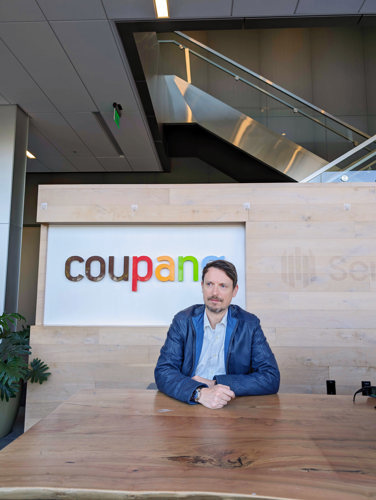
In this content, we present an interview with Jordan, a Bar Raiser trainer based in the U.S., to hear firsthand how this role operates in practice and how fairness and consistency in hiring are achieved.
Please introduce yourself and your current role.
Hello, I’m Jordan a Director of Search at Coupang, leading the Search Quality team. My team is responsible for several key components of the search stack that determine the ranking of products shown when searching on the Coupang app or website. We employ the latest ML models and work with the broader search organization to improve customer experience by ranking the most relevant and popular products at the top of the search results page. One major aspect of our work involves ML-based prediction of which products will be of most interest to customers, even when we have minimal information about those products.
Why do you believe the Bar Raiser program is especially critical in the U.S. hiring environment?
The U.S., and Silicon Valley in particular, is a fierce battlefield of competition between top AI/ML and other talents. This means that we need to recognize when we are looking at top talent in the eye and also understand that there are many talented folks with a seasoned background who do not quite make the cut despite looking really strong on paper. The interview process is crucial to distinguishing between these cases as resumes can be misleading in both directions. Therefore, our job as a Bar Raiser is to tease apart what appears to be true from what is actually true, and this takes a lot of training and experience as an interviewer. This is where Bar Raisers enter the picture. We are very well calibrated, often having hundreds of interviews under our belt, or at least having been trained by people who have. We have been through a formal process that ensures we see a candidate’s real abilities versus what their abilities appear to be on the surface.
What’s a common myth about the Bar Raiser interview in the U.S., and how would you debunk it?
I imagine the name “Bar Raiser” leads people to believe that our role is simply to raise the bar, making it harder for candidates to pass interviews. In reality, we also ensure that candidates aren’t rejected for the wrong reasons. Because we are highly calibrated, it’s true that we may hold a higher bar than some interviewers. However, this doesn’t mean our standards are unreasonably high. We focus on the key factors that should drive hiring decisions, and we differentiate those from supplementary or “nice-to-have” qualities, which are more negotiable. While it’s true that we are here to ensure we hire top talent, we are equally committed to making sure we don’t overlook candidates with strong potential, those who are clearly on a growth trajectory and well on their way to becoming top talent.
Can you share a moment when a candidate exceeded expectations during a Bar Raiser interview?
Interviewing a candidate who truly impresses you is one of the great pleasures of being a Bar Raiser. It’s great to come into contact with exceptional people but it’s important to stay objective, even when you start feeling excited about the possibility of them joining the company. Ultimately, you know you need to review all the feedback before making a final decision. We all look for different things in the interviews. For me, it’s not just about the candidate’s technical background, which is more like table stakes. What excites me most is having a meaningful, interactive discussion about a technical challenge. When you enter a state of “flow” in a technical discussion, where you are both on the same page regarding the primary objective and requirements, yet each brings something unique to the table in a complementary way, that’s when I get the sense that this candidate would be a great addition to the team. I recently had an interview like this. The candidate was highly capable and knowledgeable and had little trouble solving my system design question. What stood out was how the conversation evolved. I found myself offering ideas to enhance the candidate’s system, ideas I hadn’t considered before. The candidate responded “yes, exactly.” and then built on my suggestions with their own ideas. It felt less like an interview and more like a true collaboration. And of course, that’s exactly the kind of candidate I’d love to see join Coupang.
You’ve conducted both standard and Bar Raiser interviews. From your experience, what aspects of the Bar Raiser interview do candidates tend to find more challenging compared to regular interviews?
You can perhaps guess from my previous comments that the Bar Raiser interview should not necessarily feel harder. In college, I had a physics professor who was a Nobel laureate, and another professor who was perhaps less distinguished but placed greater emphasis on teaching, and that’s who I learned the most from. Bar Raisers are trained to be great at interviewing, so I’d like to believe that we are more like that great teacher, who makes the process feel easy. Of course, we still ask candidates some challenging questions, but even so, they shouldn’t finish the interview feeling more drained than they would after an interview with a regular interviewer.
What do you think is the most important mindset for someone to become a successful Bar Raiser?
It’s important to care about both the people you’re interviewing and the company you’re hiring for. You’re ultimately a representative of the company, and one of the key individuals candidates will remember, whether they receive an offer or decide to join. We want to leave candidates with a feeling that, even if they didn’t pass the interview, it was a positive experience overall, and they would like to try interviewing again in the future. One common mistake among interviewers is focusing entirely on weeding out underqualified candidates, without considering the cost of losing someone who could be a great fit. Think of it this way: if the candidates fail the interviews, there’s still no harm in leaving a good impression, but if they pass, the next step is hoping they accept the offer. If you wait until the offer stage to leave a good impression of the company, it’s already too late. Personally, the primary motivation for joining more than one company in the past was that I was genuinely impressed by the interview panel. It made me think “I really want to work alongside these people.” Of course, Coupang was one of them.
Looking ahead, what are your personal or professional goals at Coupang?
We are all in a continuous state of self-improvement. No one, from new graduates to senior leadership, is perfect or exempt from the need to grow in order to become more effective in their role. For better or worse, I don’t focus as much on concrete goalposts like getting promoted or managing a larger team. Instead, I focus on addressing the feedback that comes from my own internal voice. If I know I could have done something better, I make sure to improve the next time I’m in a similar situation. That’s the “fix the defects” part of growth. There’s also a forward-looking aspect of growth, in which you know that developing a particular skill, whether hard or soft, or gaining specific knowledge would make you more effective. When you observe someone else excelling in a certain area, it can inspire you to improve in that dimension as well. Surrounding yourself with the best people accelerates this process because they model what excellence looks like.
Concretely, I would like to improve in several areas: understanding cutting-edge technologies such as Generative AI, making thoughtful decisions about how to apply those technologies to benefit our customers, moving efficiently from architecture to roadmap, executing that roadmap quickly by collaborating closely with our strong engineering team and anticipating potential pitfalls, delivering meaningful outcomes to customers, and earning greater trust to take on more ambitious and impactful projects in the future. All of these stages are crucial to success but given the rapidly evolving technical landscape, the ability to understand emerging technologies and apply them effectively is likely the important lever for me at the moment.