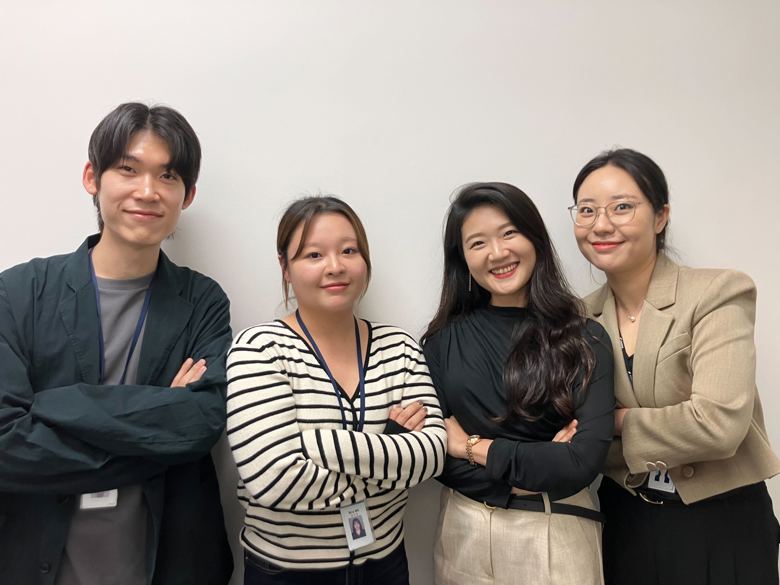
Mira: Hello, I am Mira, a Korean-English interpreter at LOIT (Logistics Ops Interpreters and Translators). While I was in graduate school, I had an opportunity to participate in Coupang’s Interpretation & Translation Internship Program. That experience really helped me understand how Coupang’s interpretation and translation system works and see what the environment is like. I actually got to experience how both online and offline interpretation are done, including the interpretation booth. I liked the fact that Coupang’s interpreters and translators were closely connected to real business environments, so I applied without any hesitation.
Wesley: I personally prefer working from the office, but I think Coupang’s hybrid workplace model, which blends remote and in-office work, is a huge merit. When I recently joined GMIT, every member helped me get used to the domain and shared their own know-how. From my own experience and what I’ve heard from other newcomers who joined around the same time, Coupang’s interpreting and translation organizations offer very well-structured onboarding programs that help new employees to settle in smoothly.
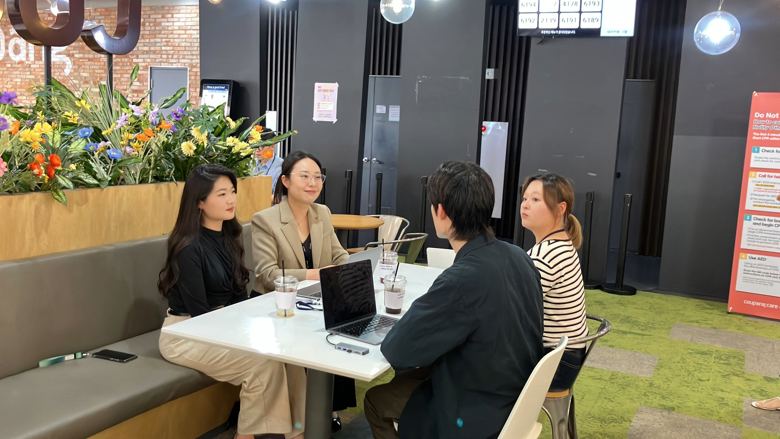
How did you prepare for the interpretation and translation tests? Are there any tips you would like to share?
Susie: I prepared for the tech interview by familiarizing myself with the major keywords of the latest news articles and reports about the e-commerce industry, as I thought it was crucial to become comfortable with industry-specific terminologies to show smooth and stable performance.
Watching YouTube videos on the e-commerce industry and shadowing ones with unfamiliar expressions were very helpful too. Reading articles from the Coupang Newsroom also provided me with valuable insights into the company’s culture and helped me learn about different teams.
Judy: I agree with Susie. Shadowing, where you listen to the audio of sample texts recorded in Korean and simultaneously interpret in Chinese, was the most helpful exercise.
I think it’s important to make your interpretation sound natural to the audience. The fast pace of the tech interview might throw you into a fluster. It’s important to maintain the flow so that the interpretation sounds as natural as possible.
Mira: I believe speed is the most important factor. When I practiced interpretation with video clips, I didn’t always interpret from beginning to end. I just played and interpreted random parts of the video to respond swiftly to any content or situation. Especially in tech interviews, if you just freeze and miss one part, there is not enough time to recover. So, I recommend getting used to fast-paced interpretation before you take the test.
Wesley: Before the tech interview, the Recruiting team provided a prep guide. I think it is important to review it several times and become familiar with it. My study group used it as study material for the interview, practicing interpreting and sharing feedback based on the guide. Everyone mentioned speed already. I would like to recommend that you practice at a faster pace than usual.
It would be also be helpful to keep an eye on Coupang and stay updated on its latest trends. I think that just having some background knowledge can help reduce your anxiety.
How do you see your career developing going forward?
Susie: My short-term goal is to get myself used to the fast-paced environment of Coupang. I also want to broaden my knowledge and understanding as I have to support a wide range of domains and meetings.
In the longer term, I aim to grow into a team member who has a good understanding of the team’s direction as well as contributes to the team by fulfilling my own responsibilities and supporting our shared goals.
Judy: As Coupang's Taiwan business is growing, so is our team. Since our team supports so many different domains, I keep records of the meetings I support every day so that I don't lose track, especially when returning to a domain meeting after a period of time. When a new interpreter joins later, I want to share these logs and pass on my know-how, just as my current team members helped me, and mutually grow.
Mira: I want to become an interpreter that users can trust. I want them to rely on me when I provide interpretation for them. Since I work closely with the business team members, they sometimes send me messages saying, “thank you” or “the meeting went well thanks to your interpretation,” which all really mean a lot to me. I hope I can build trust with the users and perfectly bridge business communications.
Wesley: I once ran into a user in charge of the business that I had interpreted for at a restaurant outside the office. He introduced me to his family and said, “I can do my work thanks to the interpreters like him.”
I believe interpreting is not just about converting one language into another but about communicating the message after clearly understanding the relationship between what is being said and why it is being said. As the user said, I want to become an interpreter that users can trust and rely on for their meeting interpretation, so I’ve been continuously studying Coupang’s various business domains and business relationships.
Thank you for joining us for the interview. Lastly, do you have anything else to share, such as your team’s unique strengths or the type of colleagues you would like to work with?
Susie: My teammates have been incredibly supportive and thoughtful — not just with their own work, but with others’ as well. Whether it’s jumping into an urgent meeting or lending a hand when someone needs help, everyone truly shows up for one another.
I want to take this opportunity to express my gratitude for the care and collaboration that defines our team. Thank you for always being there for me, even when you’re managing your own busy schedules. It really means a lot.
Judy: I feel my team has an environment that fosters proactive work and independent learning. In particiular, my team covers broad subjects of the Taiwan business, providing a unique opportunity for professional growth and knowledge accumulation. Also, it is a great opportunity to go on a business trip to Taiwan and witness firsthand how fast the business is growing there. Thanks to my colleagues who have background knowledge of various domains, I was able to hit the ground running, and it is such a pleasure to be at work.
Mira: Our team members have been truly supportive in helping me adapt at Coupang. They always ask me whether I am doing okay, which has helped me to settle in. My goal is to become an interpreter that can fully contribute to the team as soon as possible.
Wesley: I have not expressed it often, but my teammates have really helped me adjust and fit in.
I’m always truly grateful to my colleagues for sharing their know-how, giving me advice, and helping me understand the domain thoroughly from scratch, since I was all new and unfamiliar with the domain.
Everyone is thoughtful, and the team has great chemistry, so working with them makes coming to work enjoyable.