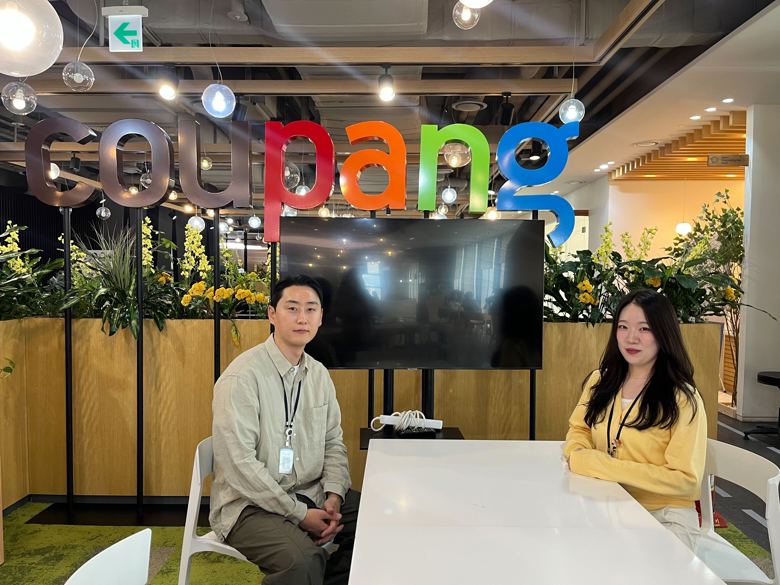
From permits to automation, the story of Handa and Douu, who drive decisions to completion in a field without clear-cut answers
Hello, could you both please introduce yourselves and your team?
Handa: Hello. I’m Handa from the Program Engineering team within Program Management. Our team handles the entire process of building new Fulfillment Centers (FC) and redesigning existing ones on an end-to-end basis, from planning to execution and completion. In the planning stage, we mitigate risks in advance through physical inspections, review of design and permits, and budget establishment. During the execution phase, we manage schedule, cost, and quality in an integrated manner while leading the actual construction. In an environment where architecture, facilities (including HVAC), automation, and IT are intertwined, we play a role in completing centers that are actually operable by considering structural, construction method, legal, and operational perspectives.
Furthermore, for redesign projects, we perform not just simple improvements but also review permit requirements and manage administrative procedures following changes in usage, structure, or facilities. We proactively manage the impact of permit risks on schedules and costs from the initial stages. Our goal is not just about building a facility, but creating results that ensure stable operations from a Company-wide Perspective.
Douu: Hello. I’m Douu from the Program Management team. As Handa mentioned, our team is responsible for the overall management of fulfillment center infrastructure development projects. We coordinate and organize from a company-wide perspective to ensure the stable completion of each project within the planned schedule and budget.
What is the scope and primary objective of your current projects?
Handa: Currently, I am performing the Program Management - Program Engineering role while handling both the construction of new FCs and the redesigning of existing centers. These projects involve large-scale fulfillment centers measuring tens of thousands of pyeong. I am involved in the entire project process, from initial design review and consultation to construction coordination and handover to the operations team. The core responsibility of my role is to connect decision-making among various stakeholders, such as internal departments and design and construction vendors, and create actionable solutions that satisfy schedule, cost, and quality needs simultaneously. Major repair projects, in particular, obtaining permits in the construction scope planning stage often determines the success of the project. As such, my primary goal is to clearly organize regulatory requirements and administrative risks related to changes in usage, structural reinforcement, and facility expansion at the early stages and proactively reflect them in the schedule and budget planning.
Unexpected constraints and variables occur repeatedly during a project, but in those moments, I prioritize taking responsibility until the problem is solved and leads to actual results, or in other words, Delivering Results with Grit even in difficult situations.
As all-rounder PMs, what do you find most attractive about this role?
Handa: I think the greatest appeal is that you can grow into someone who understands the entire project structure and designs solutions, rather than just solving isolated problems.
The role requires a PM to not only manage individual processes but also think and decide by integrating design, construction, and operations, along with constraints like major repair permitting, into a unified system. Especially in major repairs, the scope of work is often determined by the feasibility of permits, and legal interpretations and administrative procedures vary greatly depending on changes in usage, structure, or facilities. Therefore, we proactively determine the project's direction by reviewing the Building Act, related regulations, and government consultation points even before the design or construction phases. If a project starts without these considerations, it is highly likely to lead to schedule delays or cost increases during construction.
The role naturally requires an approach based on the principle “Think Systematically,” as you need to view the entire project as a single system to achieve overall optimization rather than optimization of individual areas. I believe the biggest charm of this role is the opportunity to grow into an all-rounder PM responsible for the overall structure as opposed to one single field of expertise.
Douu: Fulfillment center infrastructure projects have a very broad scope of work. They encompass automation, major repairs, electrical systems, fire safety, and IT work, as well as interior design in some cases. We deal with almost every area required for an integrated infrastructure.
Since various processes are interlocked, missing even one scope or misjudging the sequence of tasks immediately impacts the entire project schedule. Therefore, it is always necessary to have a perspective that looks at the overall flow and connections. A PM who has successfully executed a large project of establishing a fulfillment center’s infrastructure in such a complicated work environment will be able to perform any future role or position based on solid execution skills.
What is a typical daily routine for a PM?
Handa: A PM’s daily routine is not standardized. Rather, it is very fluid depending on the site’s circumstances. In the morning, I start by organizing major issues and risks related to the schedule and budget, and move on to checking the progress of construction and problem points on-site. Afterward, I focus on matters requiring design changes or schedule adjustments, discussing them with design and construction vendors, as well as with internal departments. I clearly distinguish between tasks that need immediate resolution and action items for mid-to-long-term management. Since perfect information is rarely available on-site, it is important to make the most reasonable judgment based on the current situation and execute quickly rather than waiting to have all information on hand. Fast judgment and execution on-site often reduce the overall project risk.
Therefore, a PM’s day is focused on solving actual problems and moving the project forward rather than "management to receive reports." In this regard, I believe the role of an on-site-focused PM naturally requires a Move with Urgency mindset.
Are there data or insights that can only be obtained on-site? How does traveling nationwide affect your career growth?
Handa: There is information on-site that can’t be grasped through drawings or data alone. The gap between design intent and actual construction, traffic flow and process interference, and potential risks during the operation phase can only be fundamentally understood by seeing the site in person. So, it is important on-site to dig deep into why a problem occurred and its structural causes, rather than just confirming the phenomenon. In this process, we reinterpret drawings and plans to further understand the problem.
I believe nationwide business trips are not just simple movements or repetitive tasks, but a series of processes defining and solving problems under different conditions and constraints. As these experiences accumulate, you naturally build an understanding of the sites that allow you to grasp the essence quickly and make better decisions even in different environments.
Ultimately, the site is not just a place for execution, but one that broadens PMs' thinking and sharpens their judgement and truly practices Deep Dive principle.
Douu: Discrepancies always occur between drawings and the actual site. Especially in areas where processes between vendors are interlocked, minor differences in specifications or site conditions often result in having to do the same work twice. In the process of constantly double-checking the site situation against the drawings, I feel I can more quickly acquire insights into how each process actually connects with another.
Also, traveling nationwide allows me to collaborate with various people and understand regional site characteristics, which naturally broadens my personal experiences. Having my own map of local restaurants is a bonus!
When is the most difficult moment in integrated project management?
Handa: I think the most difficult moment is when I have to make a choice in situations where multiple processes and interests are entangled. Particularly in fulfillment center infrastructure projects, permit interpretations and the feasibility of government consultations often take priority over technical or commercial judgments. This frequently results in situations where the theoretically most efficient construction method cannot be applied in reality.
Even if we want to choose a specific method or sequence to shorten the schedule or reduce costs, the overall project risk could increase if that choice leads to additional changes in permits, prior government consultations, or approval conditions regarding major repairs.
In such cases, priorities must be rearranged based on permit stability, usage approval feasibility, and the targeted go-live date rather than short-term efficiency.
Ultimately, my role is not to choose the "theoretically best plan," but to define and take responsibility for the best choice the company can actually handle, in consideration of permits, schedule, cost, and operations. This role requires Ruthless Prioritization, the ability to choose with a cool head what to give up and what to focus on.
Douu: From a practical perspective, the most difficult moment is during the CAR (Capital Approval Request) Budget review and approval process in the planning stage. While progress management in the execution phase is important, obtaining CAR approval requires a high level of understanding of the overall project WBS and schedule.
This is also the period where I communicate with the most stakeholders to align perspectives. As a PM always chased by the clock, I must request necessary data from departments and partners, interpret it quickly, and clearly explain the core points during the CAR review. Since review time is often limited, accurately conveying the project's direction and risks in a short period is challenging. Navigating this process well significantly reduces confusion and risks during execution, so I believe the CAR review in the planning stage is the moment that requires the most focus and integrated thinking from a PM.
What are the key points when collaborating with related departments and partners?
Handa: The most important point in collaborations is clarifying roles and expectations while having the power to move things forward without relying on formal authority. Since various organizations with different goals and constraints are involved, the process of aligning judgment criteria through logic and evidence is more important than just following instructions. In this regard, the role naturally requires collaboration driven by influence, not authority (Influence without Authority).
For example, instead of simply saying "No" to a plan with permit risks, it is necessary to make stakeholders see the same picture by sharing issues in the interpretation of regulations, feasibility consultation with government agencies, and the impact on schedule and cost.
Taking responsibility until the agreed direction leads to actual results is the PM's way of collaborating.
I believe it is crucial to fully understand each organization's position while clearly explaining "why this decision is necessary right now" from the perspectives of schedule, risk, and cost, and ensuring that agreed-upon items are executed to the end. As you accumulate this type of collaborative experience, I believe you can grow into a PM who naturally coordinates and delivers results even in complex environments.
Douu: While performing PM tasks, you interact with many people from various departments and vendors. Therefore, I feel that quickly grasping each person's preference and working style is just as important as the technical content.
Even if everyone does their job well, progress slows down significantly if communication styles don’t match or if perspectives are not understood. I try to identify the communication style that collaborative partners prefer, and the specific information they are sensitive to, and adjust accordingly. Through these experiences, I have come to strongly agree with the saying, "A PM's most valuable asset is their connection with people. Specifically, their human network." In practice, I feel that these relational assets are a tremendous help in navigating and solving problems within complex situations.
What are your career path expectations for the next five years? Or what career guide can you offer from a practitioner's perspective?
Handa: When discussing my future career, the keywords I value most are level of completion and standards. I believe that as project scales grow, it’s not just about "finishing" them. Rather, it's about the continuous accumulation of experiences where I set high standards for myself and produce results that meet those standards. I view this process as an example of "Demand Excellence."
Rather than simple role expansion, my direction is to build expertise in creating reliable judgment standards with regard to permits. As projects grow more complex, the difficulty of decision-making increases. However, I believe this emphasizes the importance of the ability to structurally understand permit conditions and risks and to articulate them logically.
In the long term, I want to grow into a PM who can provide clear standards to the organization by comprehensively judging permit feasibility, schedule stability, and operational suitability. My goal is to be the reference point who can explain with clear evidence, "this condition makes the project viable," or "this point is the core risk." I believe the experience of seeking better solutions within given constraints and raising the completeness of results naturally leads to career expansion.
Douu: Based on my experience as a fulfillment center construction PM, I want to expand my expertise into the field of automation facilities and robotics projects. I have become increasingly interested in System Integration (SI), understanding automation equipment, and systems and integrating them into a single flow, and my long-term goal is to grow into a professional engineer-type PM who can oversee Smart Factory construction.
Since these infrastructure projects bring together architecture, facilities, automation, and IT, I believe this experience is a great foundation for expanding into automation and smart manufacturing.
What kind of person would be a good fit for the team?
Handa: I think someone who does not hesitate to dive into problems with no fixed answer would be a good fit. It is important to have a Company-wide Perspective, accepting on-site issues not as problems for an individual or specific organization, but as tasks for the entire company to solve together.
Also, someone who can make the best possible judgment in the current situation, take action, and then adjust the direction by learning through the process, rather than waiting for perfect information, will be able to grow quickly. A tendency to naturally practice Move with Urgency fits this role well.
Someone who possesses a Learn Voraciously attitude, constantly contemplating better ways rather than just doing what is assigned, will experience great growth. Above all, I believe someone who can move things forward by persuading others with logic rather than authority and take responsibility for the results will find great achievement here.
Douu: Coupang operates in an environment that is highly sensitive to changes in demand. While working on a project, designs or directions that have been in preparation for a long time can suddenly change. Therefore, someone who is comfortable with rapid change and can adapt flexibly, rather than being stressed by it, is a good fit for this team.
Do you have any advice for prospective applicants regarding this role?
Handa: This role is certainly not an easy one. However, if you want to create results that have a real impact on customers (Wow the Customer) and want the experience of setting high standards and seeing them through (Demand Excellence), you’ll be able to grow very quickly in this environment. Since problems on-site are rarely solved at once and require digging deep into the causes, you need to be willing to have a grasp on the essence (Dive Deep) rather than just having a superficial understanding. At the same time, you will repeatedly experience Ruthless Prioritization, choosing with a level head what is most important when you cannot do everything, and Influence without Authority, persuading departments and partners to move forward.
If you want to expand your limits by learning quickly (Learn Voraciously), executing without hesitation even when situations change (Move with Urgency), and ultimately creating results, this job is well worth the challenge. It’s natural not to know everything at first, so I recommend observing the site as much as possible and never hesitating to ask questions.
Douu: The role as a fulfillment center construction PM involves many tasks that must be handled simultaneously in an environment where unexpected issues always arise. Therefore, multitasking ability and a meticulous tendency to not miss even a small task are very important.
You don't need to be perfect at everything from the start. However, if you have the capacity to persevere and organize issues one by one, even in complex situations, I believe this is a role where you can definitely grow.
While it is not an easy path, the sense of accomplishment and the scale of professional growth it offers upon success are immense. Therefore, I would say it is a position well worth challenging for anyone who desires to elevate themselves to the next level.